
A conversation with Vauhini Vara about AI, writing and storytelling
- On 9 August 2021, the online magazine “The Believer” published your essay Ghosts, co-written with GPT-3, an ancestor of what we now know as ChatGPT. Five years later, it is still one of the most accomplished and surprising examples of creative collaboration with a machine: a kind of “maieutic” dialogue that came out of an iterative process of nine attempts, in which your own “human” part grows step by step until it absorbs the machine’s. The form seems to mirror both the title and the story you tell. The “ghosts” of the title make us think of Cibernetica e fantasmi (Cybernetics and Ghosts), the lecture Italo Calvino gave in 1967, later collected in Una pietra sopra (available in English in The Uses of Literature, translated by Patrick Creagh, Harcourt, 1986). In that text, written at the very beginning of artificial intelligence, Calvino seemed to suggest, almost provocatively, that one day machines might replace the author, but that the “ghosts” of the individual and of society (to simplify: history, myth, the irrational) would always be what guarantees the poetic result. So, what are the ghosts that haunt your text?
I tend to push back against the notion that “collaboration” — which has historically referred to people working together with a shared goal — is the right term here. (Would we refer to ourselves as “collaborating” with Google when we do a search online? Or with Instagram when we make a post?) Calvino’s conception of the storytelling machine doesn’t take into account how the owner of any machine invariably shapes its output. The output of GPT-3, in “Ghosts,” certainly reflects human culture, but it’s a subset of human culture that reflects the goals and values of OpenAI, the lab behind it.
The data set behind OpenAI’s earliest models relied heavily on scraping Wikipedia and Reddit, and English-language content was disproportionately represented in them; some research suggests that, to the extent that those models relied on creative writing, much of that text was romance published online. It makes sense, then, that “Ghosts” — especially early on — tends toward meet-cutes and other romance tropes. There must have been a fair amount of material in the training data about grief, too.
The newer models from OpenAI and other commercial labs have been fine-tuned to be much more predictable than the older ones — including GPT-3 — because predictability makes for a better product. Probably as a result, research shows that the models’ output tends to be a lot narrower and less creative than what people tend to write. Here, too, we can see that the ghosts lurking inside AI models’ output, to use Calvino’s framing, are hand-picked by the companies behind them, to serve their commercial goals.
.jpg)
(courtesy of Vauhini Vara)
- In your latest book, the essay collection Searches: Selfhood in the Digital Age, you included a revised and updated version of Ghosts, with a different ending that is clearly more “political”: in the original version the last words were generated by GPT-3, while here they have been deleted and replaced, so that the voice closing the text is now yours. Why does this change matter so much?
I don’t see it as more political, myself, but I do see it as more explicit.
When I published “Ghosts,” I expected that many, if not most, readers would read it as representing a kind of internal battle: one that pitted my desire for authentic self-expression and communication, despite the difficulty of it, against my desire for ease even at the cost of authentic self-expression and communication. I also thought people would see that the side of good — that is, of authentic self-expression and communication — wins out at the end, but only after some sacrifice of selfhood: The AI lab behind the product now knows my secrets and can monetize them as it wishes; it has also, in ways I might not even be aware of, inevitably influenced even my writing in the essay.
In the initial version, the way in which I showed the side of good winning was by literally having the proportion of my language to the language of the AI model increase over time — but still, I ended up giving the AI model the last word. The goal had been to let its continued influence show through even in this last version; the model has absorbed all of my writing, even to the last moment.
The reason I changed the ending, ultimately, is that I noticed that after the essay was published, much of the reaction was just: Wow, interesting essay! Maybe AI models really can write! I thought I had maybe been too subtle with the first version, made some of the subtext too implicit. In the new version, the last section of the essay is entirely mine; as a reader, then, you can recognize that there’s an entire section — the most authentic one — that is in fact being kept from the model. The side of good wins out more clearly; the essay is perhaps less nuanced in this version, but more clear.
- In reconstructing the story of a traumatic event, which by its nature tries to escape memory, Ghosts comes close to what in clinical practice is called “scaffolding”: the support of a “more expert” person who helps a “less expert” one carry out a task they could not complete alone. Here, however, the work of narrative reconstruction did not happen through a real person, but through a dialogue with a generative AI chatbot. And this seems to be exactly where the artistic value of the text comes from: from your refusal of the falsehoods the machine kept producing, and from the rewriting they pushed you toward. From a certain point of view, these tools seem almost made to enter our private lives and intimacy. Is this something to be aware of while using them? And what does it mean for the user?
Yes. One goal of the essay was to force people to consider what’s left unspoken: the fact that, in sharing all this deeply personal information and self-reflection with an AI chatbot, I’m also sharing it with the entity behind the chatbot — an AI lab that, even back when I published the essay, people (myself included) assumed would one day be a for-profit entity. OpenAI recently announced that it will include ads embedded in ChatGPT output. Here you can see clearly the implications of my decision to process my grief using a chatbot; the company behind that chatbot can now use that information to influence me.
- With Ghosts one has the impression of entering new literary territory, which goes beyond electronic literature as well. It is a text in which the machine could have stayed hidden: nothing on the page itself shows what you wrote and what GPT-3 generated, and without the note that opens the text — where you state which sentences are yours, which come from the machine, and what changes were made to the output — the reader would have had no way of recognizing that presence. Is that note a frame outside the work, or is it part of the work itself? In other words: without that statement, would Ghosts still be Ghosts?
The disclosure, to me, is a crucial part of the work. It would be impossible to read the essay as I hope for it to be read — critically, that is — without knowing that part of the text is generated by a predecessor to a corporate chatbot.
(courtesy of Vauhini Vara)
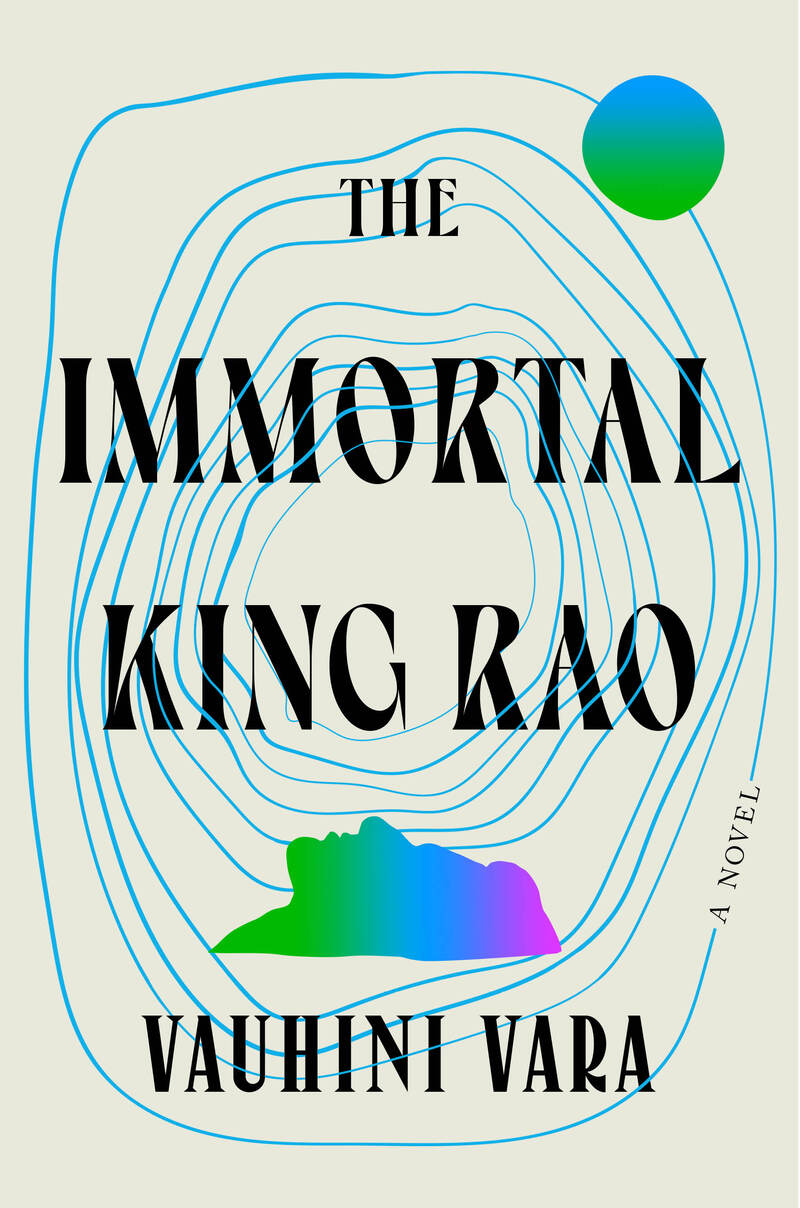
- In your first novel, The Immortal King Rao (2022; Italian edition Guanda, 2024), a finalist for the 2023 Pulitzer Prize, the narrator is seventeen-year-old Athena, King Rao’s daughter: her brain is connected to the internet through an experimental technology, the Harmonica, and through its later development, the Clarinet, it holds her father’s memories. On the one hand, giving the story to a character whose memory is technically not her own seems almost to “pretend” that the narrator is a kind of enhanced LLM (Large Language Model); on the other, the billionaire’s wish to reach immortality by preserving his memories in his daughter’s brain is very close to that of billionaires of our own time, from Larry Page to Elon Musk. In your novel, technologies that were once only “imagined” become part of everyday reality, or goals of a future that no longer feels so science-fictional. Is the spread of these technologies, and not only AI, already changing and redefining our collective imagination?
Thankfully, we don’t yet have a technology that allows people to implant their memories into someone else’s mind! That said, yeah, it is notable that the richest and most powerful people in the world have fastened on this as a technical problem they’d like to solve. It’s worth asking what makes solving that problem valuable to them; the answer is terrifying.
- In your “New Yorker” article What if Readers Like A.I.-Generated Fiction?, you showed that readers, even highly educated ones, are starting to find it difficult to tell which (short) texts have been generated artificially, especially when the models have been trained to imitate a writer’s voice. This situation seems to make Roland Barthes’s words on the “death of the author” almost prophetic. Let’s imagine, just for the sake of argument, that in the future generative AI models manage to produce great literature: should this frighten us? In Do Androids Dream of Electric Sheep?, Rick Deckard cannot take any pleasure in the talent of the android Luba Luft: when the other bounty hunter, Phil Resch, “retires” her (that is, kills her), Deckard says she was a wonderful singer and that the planet could have used her, calls what has just happened madness, and says he does not want to continue his job. Going back to the previous question: what would it mean to recognize artistic value in a non-human entity?
I think we have decisions to make about how to define art in the first place. Is a honeycomb art? Are the images from the James Webb Space Telescope of the Pillars of Creation art? Is a Google search result art? What can our answers to those questions tell us about whether AI-generated text or images can be considered art? I think we can have both individual and communal answers to these questions; I also think they’re difficult questions to answer. On the one hand, a honeycomb is beautiful and built with intent; on the other hand, its main purpose is functional, and the builders aren’t human. By addressing each of these questions, we can make a sort of check list of factors that we associate with art. Is beauty required? Is intent required? Is human involvement required? Is corporate non-involvement required?
- When people talk about generative AI, the discussion often turns to the same recurring questions: whether machines can really write well, whether they are creative, whether they will take the place of people working in the arts, and then the ethical issues and the environmental impact of these technologies. These are necessary and unavoidable questions, but there is a risk of losing sight of something equally important: the deep transformations of our culture that are already under way. In this new landscape in which non-human entities take part in artistic production, are there crucial aspects we are not paying enough attention to?
The output of AI models — all this slop — is already invading the internet and even the offline world. One element of this that I think needs to be paid more attention is the way in which, if all self-expression and communication represents the values and goals of a given speaker, it follows that vast amounts of text and imagery appearing in front of us now represent the values and goals of a tiny number of wealthy, powerful tech companies and their backers.
Vauhini Vara is the author of Searches: Selfhood in the Digital Age, which won the Porchlight Business Book Award and was named one of the ten best books of the year by Publisher’s Weekly. Her previous books are This Is Salvaged, which was longlisted for the Story Prize and won the High Plains Book Award, and The Immortal King Rao, a Pulitzer Prize finalist and winner of the Colorado Book Award. She is also a journalist, for publications including Businessweek, The Atlantic, and The New Yorker. She mentors writers on book-length projects through the Lighthouse Writers Workshop’s Book Project and the Look2Justice Free Thinker Book Fellowship.