
A conversation with Nina Beguš on Artificial Humanities
1. In your book Artificial Humanities: A Fictional Perspective on Language in AI (University of Michigan Press, 2025), you proposed and defined the new theoretical framework of “artificial humanities”: an interdisciplinary field in which AI is studied through the tools and methods of the humanities, and which can help us understand and guide the design of these technological systems. Could you tell us about the path that led you to develop artificial humanities, and what specific contribution they can offer to the study of and debate around AI?
Fields are born out of need: cutting-edge questions require a new conceptual framework or a new scientific method. I realized that artificial humanities are needed for both human disciplines and scientific and engineering ones once I started speaking to engineers in the early 2010s. They built social robots and autonomous vehicles and clearly needed humanistic knowledge to address their day-to-day, seemingly merely technical challenges.
It took another decade for the humanities to recognize that they need to be at the forefront of this development while computer science had realized it much earlier. As a matter of fact, we had Philip Agre, a computer scientist turned humanist, who argued that AI is philosophical underneath already in the 1990s—but nobody understood this until now.
Artificial humanities are positioned as a collaborative and generative framework, centering the concepts we are working with and how we translate them into the technical reality, bringing forth fiction and narratives that drive the way we build and interact with technologies, and examining historical continuities and legal, social, and cultural interplays between the humanities and technologies (be it AI or neurotechnology, biotechnology, and whatever comes our way in the future).
2. Artificial humanities present interdisciplinarity not as an objective, but as a necessity. From this perspective, however, the proposal for a dialogue between the humanities and STEM disciplines may appear similar to the approach of digital humanities, a field of study that has long been rooted in academic curricula. In what ways does the interdisciplinary approach of artificial humanities differ from that of digital humanities?
Artificial humanities turn the vector of digital humanities: if digital humanities use computational methods to study humanistic materials, artificial humanities use humanistic methods for computational materials. Time will tell if artificial humanities are a subfield or an adjacent field to digital humanities. They certainly interact with media studies, science and technology studies, rhetoric, literary and film studies, ethics and policy, and so on.
This interdisciplinarity is necessary due to the nature of our challenges. Machine learning is now inherently interdisciplinary: aside from software engineers, we have mathematicians, neuroscientists, and philosophers. It is important for the humanities to be a part of this development and not, as they were prior to this, a critical afterthought. The challenge is too big for the technologists to bear it alone.
3. In the book, you use the myth of Pygmalion as a kind of “imaginative matrix” that has shaped the way we think about, design and narrate AI. Starting from this case and from other recurring imaginaries in literature and film, could you explain concretely how the humanities can help us understand and design AI and other technological systems?
The sociotechnical nature of our technologies cannot be underestimated, especially with generative AI which is a highly cultural technology. Silicon Valley likes to act as if its ideas have no history because it needs to sell everything as if it’s new. Every product—say chatbots, virtual assistants, and virtual beings—is built on both technical and conceptual thinking. One major metaphor in the history and development of AI is that it was imagined as a human mind. So was the Turing test as a benchmark as well as the first chatbot ELIZA, named after the character from Shaw’s play Pygmalion. This anthropomorphic conception of AI is a projection made for our convenience: humans inherently anthropomorphize. This is what the humanities can point out and, further, help us explore other options and opportunities.
Our narratives and imaginaries are doing a lot of work in tech spaces and thus have an unprecedented amount of power, influence, and potential. When I started working on the Pygmalion myth in relation to AI I was surprised how much these scripts inform each other. For me, it began with ELIZA, Siri, and Replika in comparison to the Hollywood films Her, Ex Machina, and Lars and the Real Girl. It is really hard to break out of this mold: all of these films have tried for a moment and failed.
4. In one passage of the book, you write that “even if we might perceive the AI system as humanlike, it is essential to conceptualize, build, and use AI as a fundamentally nonhuman agent.” Why is it so important to move beyond the illusion of anthropomorphic AI, and how can we do so?
I am not sure we can move away from it, but it is important to explore the machinic potential beyond this projection. I had to look far and wide to find fictional examples where machines are not anthropomorphized (I found it in Stanisław Lem’s oeuvre). This is a surprising finding considering that in fiction your landscape is unbounded by imagination. And yet, we seem to be coming back to millennia-old myths, such as Pygmalion, Prometheus, Narcissus, and Midas.
I wanted to offer the generative nature of artificial humanities to break into the realm of liminality since our old concepts don’t hold for the new conditions we have created. This will take work and time, and can only be done by deeply engaging with the matter—through science, technology, art, philosophy, fiction. I’ve extended my work in these directions, creating speech GAN models, artistic works, reflective essays, scientific studies, and a new book series, and I hope the framework inspires other scholars, artists, and technologists to try as well. I see students majoring in artificial humanities and artists, such as Pierre Huyghe whose work I put on the cover, building upon it. Hollywood is responding by reading the book: in November, I’ll discuss it with my favorite director Denis Villeneuve.
5. Language, together with intelligence, is one of the most contested human attributes when we speak about AI. Today, machines do not merely co-create human language; they also collaborate in the production of texts, images, and cultural artifacts. Reactions seem to polarize between those who reduce AI outputs to mere statistical combination and those who, instead, tend to attribute intentionality or consciousness to machines. How should we interpret this new nonhuman linguistic agency?
Language has found itself in a space of tension. This is because our concept of language has become outdated with LLMs producing a deluge of glib, polished text and using language as an interface to create images. So language is under a lot of pressure in the computing world. There is also pressure from the other side of the nonhuman: animal communication research, which has shown that we share more properties of language than we had thought. Language is undergoing a similar shift than when we recognized animals as using tools.
It’s misleading to think of AI as merely LLMs, even though they are at the forefront of every discussion. Machine learning has opened a new tinkering space for us, the way figuring out the physics of flying has opened opportunities for humans to fly in a number of ways: airplanes, kites, helicopters, drones, rockets, gliders, etc. This is why I’m working with speech-based GANs, which produce language differently from textual and humongous LLMs and are closer to how infants acquire speech.
I’m bringing all these aspects together to revamp our criteria around language as the production of an existential subjectivity that could only be the meaning-producing human, which is how the deniers conceptualize it. The hype crowd likes to use the term consciousness, which was also invented for humans back in the 17th century by John Locke, building on Descartes. Concepts are artificial: they are born when we need them, and we can discard them and create new ones. My proposal in this debate is to reconsider language as a spectrum.
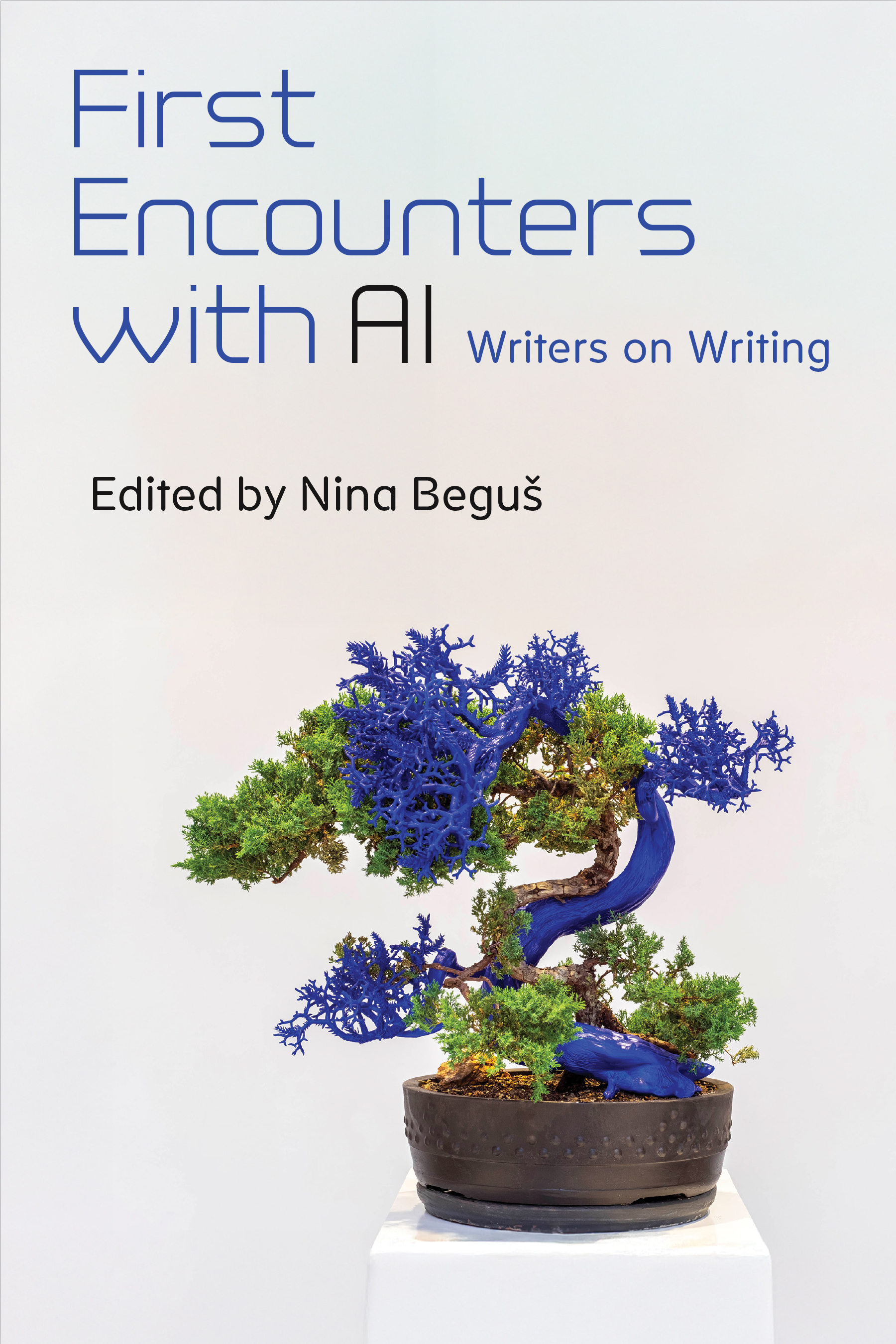
6. In November, your new work First Encounters with AI (University of Michigan Press, 2026) will be published. In it, you have collected and edited essays by writers engaging with the arrival of generative AI in their creative practice. If you can share something in advance, what picture emerges today of the collaboration between humans and machines in writing? Which, if any, seems to prevail: fear, curiosity, resistance or experimentation?
All of it. What really prevails is humanity, with all the strengths and frailty we bring. I created this volume because I wanted to bring more nuance to public discussions around AI. I don’t think we unrolled AI systems in the best way: they concern all of us, yet the overwhelming majority of people have no say in how AI gets developed. There are so many other ways of building AI. So there’s an optimistic streak our volume holds, believing in the meaningful future for writing, now altered by AI.
The volume is both a diagnosis and a chart for the future of writing. Individual essays both converge and clash. Qiufan Chen explains how AI misses vertical depth, and Hannes Bajohr illustrates how surface narration works. Joseph Dumit and Con Diaz find a way to explore its inner workings, and Jasmin B. Frelih meditates on the plurality of our inner life, which remains unavailable to models. Ted Chiang famously says AI has no intent, and Allison Parrish that there is no desire in machinic creation. While James Yu tries to provide a solution to writer’s block and a sparring partner in a machine, Nicholas Nardini, at home in the writers’ room, begs to experience it again. Sheila Heti narrates the attachments we develop with chatbots, and Katy Gero argues how we should develop LLMs differently. Ken Liu looks at the history of scribes being replaced by print and considers machines master imitators. Sasha Stiles and Iain S. Thomas show us the ways they are using AI to extend their writing. Annelyse Gelman puts Claude into a poetry workshop and concludes, reluctantly, that machines can write poetry. Alex Saum-Pascual finds in writing our relationality and resilience in spite of the threats we feel on the ground of yet another technological revolution. It is an honest confrontation with what is at stake for creativity, both for writers and readers.
7. Writing is a transversal skill and does not concern literature alone. Generative AI is already present in schools, universities, social media and many professional fields. One has the impression that new generations may one day struggle to imagine that, in the past, it was possible to write starting from the so-called “blank page”, and may come to see writing as an assisted, dialogic practice mediated by artificial systems. What risks and possibilities open up in this cultural transition, and how can artificial humanities help us interpret and tackle it?
Our grandchildren might be surprised to hear we used to write from scratch. But we are also analog in our being—we cherish the embodiment that writing by hand provides, even though it is clear that schools are switching from cursive to keyboards. It’s important to identify what skills and values we want to preserve for future generations.
In the long history of writing, the interface has been similar: a chisel and a tablet, a pen and a letter, a typewriter and paper, a keyboard and a screen. For writers, this is a colossal change in the history of writing, more than for visual artists who have been tinkering with a greater variety of tools.
The arts and humanities have an incredible ability to identify historical continuities and conceptual ruptures, to provide tools that address the qualitative, cultural and social sides of the technology, and to help us navigate uncharted waters with philosophical dignity.
Nina Beguš is a researcher at the University of California Berkeley, where she leads the Artificial Humanities Group. She is the author of Artificial Humanities: A Fictional Perspective on Language in AI and the editor of First Encounters with AI: Writers on Writing.